A wallet can show assets from several networks in one interface, yet nothing has physically “moved” from one blockchain to another. That counterintuitive fact explains much of the confusion around multi-chain wallets and cross-chain swaps. The wallet is usually the control panel; the bridge, exchange protocol, liquidity provider, and destination chain do the settlement. For US DeFi users, this distinction matters because a polished transaction screen can conceal very different technical and security assumptions.
Rabby’s recent positioning as a wallet for Ethereum and EVM chains reflects a broader shift in how people use DeFi: not as a collection of isolated networks, but as a fragmented market connected by routes. The convenience is real. So is the risk. The useful question is not simply whether a wallet “supports” a chain. It is whether the user can understand what will be signed, who controls the route, where value is held during execution, and what happens if one component fails.
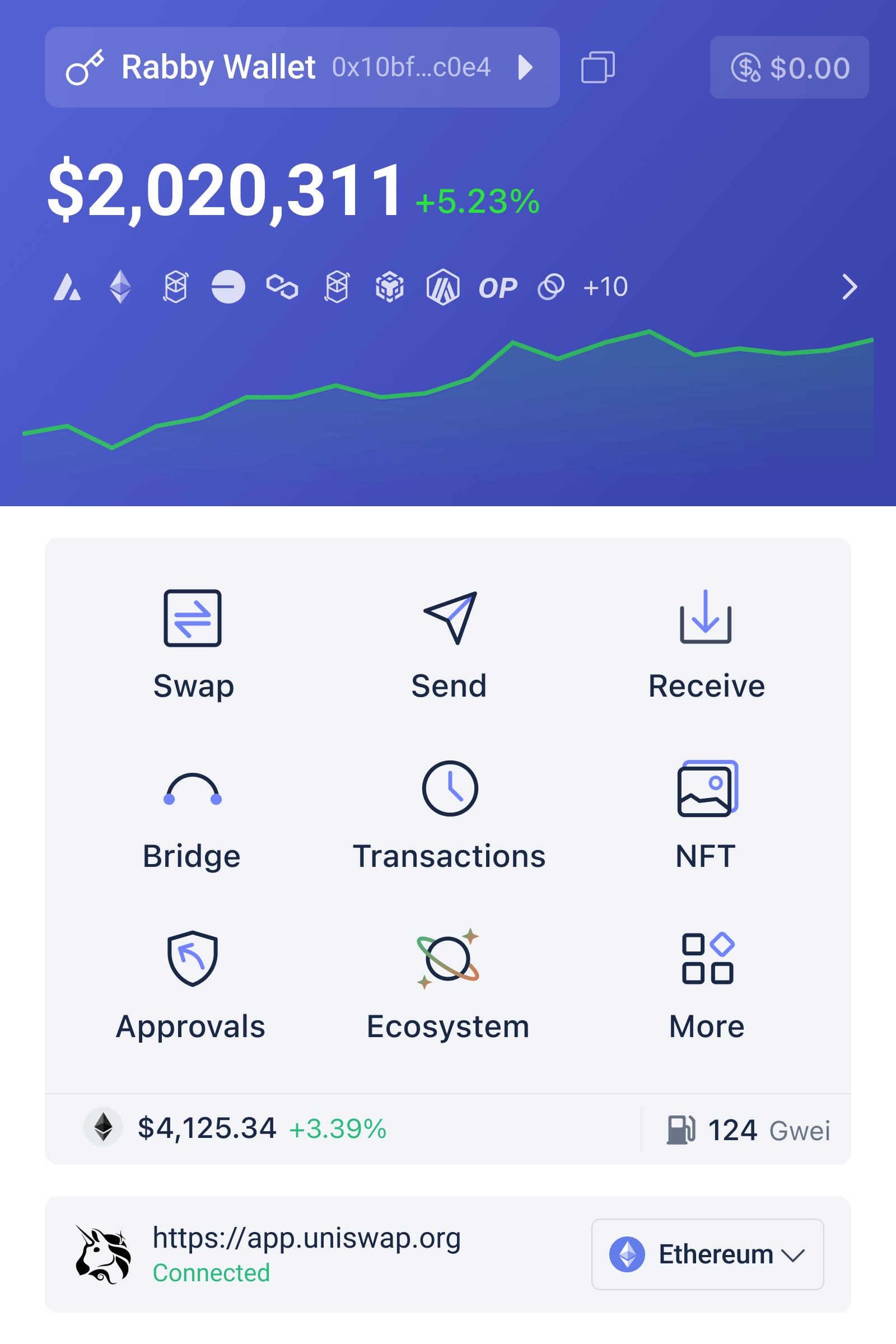
A multi-chain wallet is an interface to many security domains
Most EVM-compatible networks share transaction conventions with Ethereum, but they do not share one universal state. Each chain has its own validators or sequencing process, fee market, block history, token contracts, and operational risks. A wallet may derive addresses for several of these networks from one seed phrase or hardware device, while the underlying accounts remain separate from a settlement perspective.
This creates an important mental model: one key-management system can govern many independent environments. That is efficient, but it concentrates consequences. If a seed phrase is exposed, the attacker may gain access across every connected network. Conversely, if one chain experiences congestion or a faulty application, that does not automatically compromise the others. The wallet is unified; the trust boundaries are not.
Wallet software also does more than display balances. It interprets contract calls, estimates fees, identifies token approvals, and presents transaction simulations or warnings where available. Those features can reduce cognitive load, but they are not proof that a transaction is safe. A wallet can explain what a contract appears to request; it cannot guarantee that an external protocol will behave honestly after the transaction is confirmed.
What a cross-chain swap really does
“Swap” is often used as if it describes one atomic action. Across chains, it usually describes a sequence. A user may exchange an asset on one network for another asset on a different network through a route that combines a bridge with one or more decentralized exchanges. The source token can be locked, burned, or transferred to a settlement contract. A corresponding asset may then be minted or released on the destination chain, followed by a market trade if the desired token is different.
Other routes rely on liquidity providers. In that design, a provider advances liquidity on the destination chain and later receives the source-side asset or a claim against it. This can be faster than waiting for a canonical message to travel between networks, but speed depends on available inventory and the provider’s solvency and operational reliability.
The distinction between canonical messaging, liquidity networks, wrapped representations, and ordinary exchange routing is not academic. It determines what can go wrong. A wrapped asset depends on the issuer or bridge mechanism maintaining redemption. A liquidity route depends on inventory, pricing, and relayers. A message-passing system depends on the security of its verification and execution layers. The interface may present all of them as a single “swap,” even though their failure modes differ sharply.
There is also a timing issue. On one chain, a transaction may be final enough for a protocol to act; on another, the corresponding message may still be pending. A user can therefore see a successful source transaction without yet having usable destination funds. This is not necessarily an error. It is a consequence of composing systems with different confirmation and finality assumptions.
The hidden economics: route quality is more than the quoted rate
A cross-chain quote should be read as a bundle of costs, not a single exchange price. The total result can include source-chain gas, destination-chain gas, bridge or relayer fees, liquidity-provider fees, price impact, and slippage—the difference between the expected and executed price. A route offering a slightly worse headline rate may be preferable if it uses deeper liquidity or avoids an additional approval and contract interaction.
Gas creates a particularly practical problem for newcomers. Receiving an asset on a destination chain does not always provide the native token needed to make the next transaction. A user may hold a stablecoin on a network but lack the small amount of that network’s native asset required to approve, swap, or transfer it. A thoughtful workflow therefore considers the next action, not merely the destination balance.
For larger trades, liquidity depth matters more than the number of supported chains. A route can be technically available but economically poor if the relevant pool is thin. This is one reason to compare the minimum received amount, route composition, and expected execution time rather than choosing only by apparent convenience.
Security begins before the signature
The most dangerous wallet habit is treating a signature request as a routine confirmation. A transaction may grant a token allowance, call a router, transfer assets, or interact with a contract whose behavior is difficult to interpret. A signature may also be off-chain: a message that appears free because it costs no gas can still authorize an order, permit, or other action depending on the protocol.
Before installing any browser wallet extension, US users should verify the source, check the extension’s permissions, and create or import accounts only through a process they understand. A legitimate wallet will never need a seed phrase pasted into a website, support chat, or recovery form. If a setup page asks for those words in an unusual context, stop. For users seeking the official installation path, the rabby wallet extension should be obtained through a source they have independently verified rather than through an advertisement or unsolicited message.
Hardware wallets can reduce exposure of private keys, but they do not eliminate application risk. The device may protect the key while the user approves a malicious contract call. Transaction simulation, address screening, and readable prompts are useful layers; they are not substitutes for checking the domain, protocol, token address, spender, and requested amount.
Approvals deserve special attention. An unlimited allowance can let a contract spend a token later, subject to the contract’s permissions and the token’s behavior. Reusing approvals is convenient, but it expands the time window in which a compromised or malicious spender could matter. Revoking stale approvals can reduce exposure, although the revocation itself costs gas and does not undo transfers already authorized.
A practical framework for evaluating a route
Use five questions before confirming a cross-chain transaction. First, what exactly is being exchanged, and is the destination asset native, bridged, or merely a similarly named token? Second, which protocols and contracts will receive authority or funds? Third, who provides destination liquidity, and what happens if that liquidity disappears? Fourth, how much native gas will be available after settlement? Fifth, what is the recovery path if the source succeeds but the destination step stalls?
This framework exposes a common misconception: the safest route is not always the shortest route, and the cheapest route is not always the one with the lowest total risk. A route with fewer visible clicks may rely on a more complex backend. Conversely, splitting an operation into separate bridge and swap transactions may improve transparency while increasing user error and gas costs. The right choice depends on amount, urgency, liquidity, and the user’s ability to inspect each step.
For a first transaction, a small test transfer is often more informative than theoretical reassurance. Confirm the destination network, token contract, wallet address, expected gas asset, and settlement behavior. Once the test completes, larger transfers can follow with clearer expectations. This is especially sensible when interacting with a new bridge or an unfamiliar EVM chain.
What to watch as wallets become more intelligent
Wallets are likely to compete increasingly on interpretation rather than simple key storage. Better simulations, clearer risk signals, route comparisons, and chain-aware balance management could make complex DeFi actions more understandable. The conditional benefit is substantial: if these tools accurately model contract behavior and clearly communicate uncertainty, they can reduce avoidable mistakes.
The boundary is equally important. Automated warnings are generated from available data and assumptions. They may miss a newly deployed exploit, an economic attack, a governance change, or a malicious front end that behaves differently after signing. Users should treat wallet intelligence as decision support, not an oracle of safety.
The deeper trend is toward abstraction. Users want one balance view and one action flow, while blockchains remain separate systems with separate incentives. Good wallet design can hide unnecessary complexity, but it should not hide meaningful risk. The strongest interface is not the one that makes every transaction look effortless; it is the one that makes important differences visible at the moment they affect a decision.
Frequently asked questions
Does a multi-chain wallet combine all my assets into one blockchain account?
No. It can display and manage accounts across multiple networks, but each chain maintains its own balances and transaction history. The same address format may appear on several EVM chains, yet the assets and state remain network-specific.
Is a cross-chain swap safer than using a centralized exchange?
Neither category is automatically safer. Cross-chain DeFi can provide direct control and transparent settlement, but it introduces smart-contract, bridge, liquidity, routing, and signing risks. A centralized exchange introduces custody, account, withdrawal, and platform-solvency risks. The relevant comparison is which risks the user understands and can manage.
Why did my wallet receive tokens but still fail to make another transaction?
The destination token may have arrived without the network’s native gas asset. You may also be waiting for a message or settlement step to complete, or the received token may be a bridged representation that requires a different route. Check the destination chain, token contract, transaction status, and gas balance before trying again.